
DuckDB vs MongoDB: Two Databases, Two Different Jobs — Which One Does a Finance Team Need? (2026)
One stores your app. One analyses your ledger.
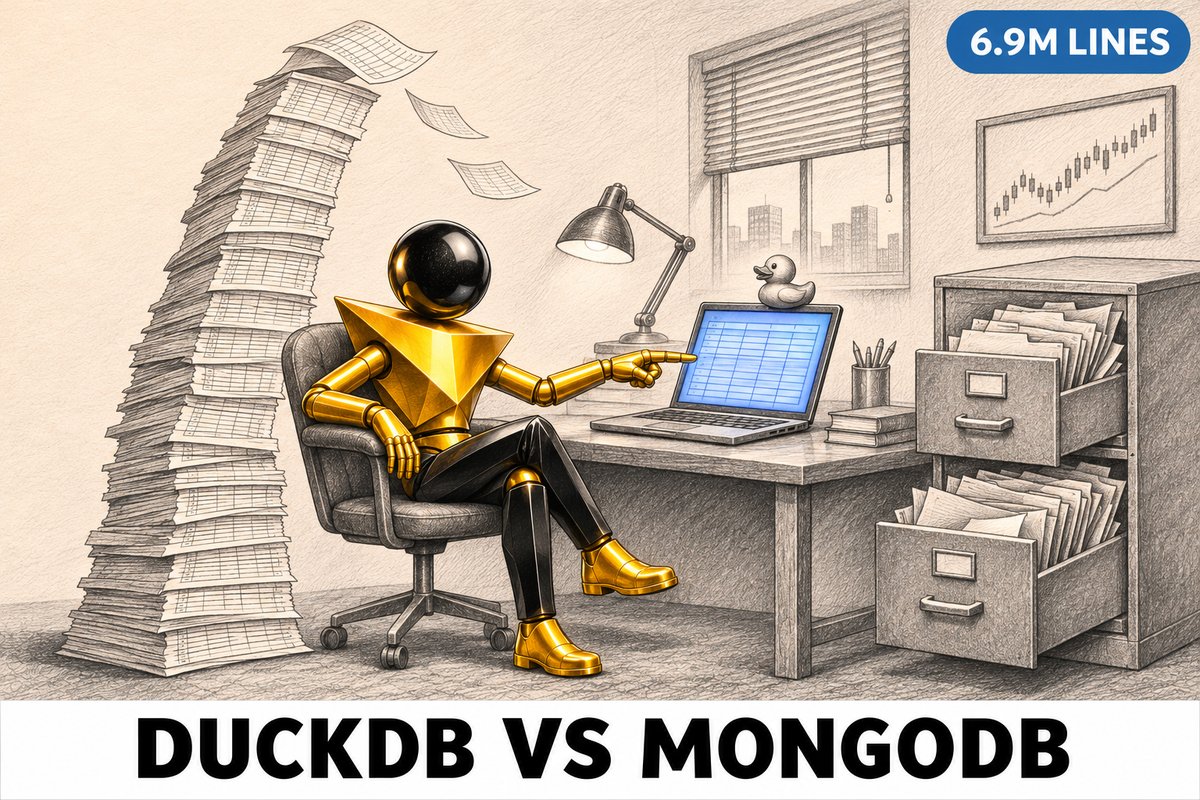
DuckDB and MongoDB are both called databases, but they were built for different jobs. This story explains where each came from, what each solved, what is still missing — and runs a test on 6.9 million general-ledger lines to show what DuckDB does for a finance team.
By findi360 · Updated 16 November 2026 · Sources · Discussion (0)
The short answer
DuckDB and MongoDB are not rivals. MongoDB stores an application’s live records — orders, users, app events — as flexible documents on a server. DuckDB is an analytical SQL database that runs inside your own Python, R or command line and answers questions on big tables and files, with no server to set up. Finance teams mostly analyse, so DuckDB is the closer fit; MongoDB is usually a source system you extract data from.
The test in three numbers
Five everyday finance queries on a 6,884,744-line general ledger, run with DuckDB and with pandas (Python’s data-frame library). Both gave the same answers.
- 7× faster DuckDB 0.86 s against pandas 5.94 s for all five queries, loading included.
- 12× less memory DuckDB peaked at 292 MB; pandas needed 3,426 MB to hold the ledger.
- 7 sheets in Excel A worksheet stops at 1,048,576 rows — this ledger would fill seven.
Where MongoDB came from
MongoDB started inside a New York company called 10gen, founded in 2007 to build a cloud platform for web applications. The team could not find a database that suited the platform, so they wrote one. Developers liked the database more than the platform, and 10gen kept the database and dropped the rest.
MongoDB was released as open source in February 2009 (version 1.0 followed in August 2009), and 10gen renamed itself MongoDB Inc. in 2013. Its cloud service, Atlas, launched in 2016 and became most of the company’s revenue.
Where DuckDB came from
DuckDB began in 2018 at CWI, the Dutch national research institute for mathematics and computer science in Amsterdam, where two database researchers, Mark Raasveldt and Hannes Mühleisen, noticed that people who analyse data — R and Python users — loved their data but hated setting up databases.
They built an analytical database that runs inside the analyst’s own program, like SQLite does for app data, and announced version 0.1 at the SIGMOD conference in 2019. The name comes from Mühleisen’s pet duck, Wilbur.
What MongoDB solved
Web applications change every week, and rigid tables made every new field a redesign. MongoDB stores each record as a flexible JSON-like document — one customer can have a loyalty tier, the next can have three devices — and spreads the data across many servers as an app grows. That made it the best-known database of the NoSQL wave.
- Built for: live orders, user profiles, app events, content — data that changes all the time (OLTP).
- Harder for: joins and large analysis across many documents — the work finance teams do most.
- Licence: since 16 October 2018 the free Community edition uses MongoDB’s Server Side Public License (SSPL), which the Open Source Initiative has not approved.
What DuckDB does now
DuckDB runs inside Python, R, Java or its own command line and reads CSV, Parquet, JSON and Excel files directly with plain SQL — no server, no import step. It stores data by column, so a question about amounts by entity reads only those two columns, not the whole ledger.
- DuckDB 1.0 (3 June 2024) fixed the file format; DuckDB 2.0.0 (21 October 2026) is its biggest feature release, with long-term support to October 2027.
- On 26 August 2026 the company behind DuckDB announced it is joining Amazon Web Services; the team stays in Amsterdam and DuckDB stays open source under the MIT licence.
- It is downloaded more than a million times a day.
How we got here — from tables to ducks
Big data moved to clusters of servers, then came back to the laptop.
- 1970 Edgar F. Codd publishes the relational model Tables, keys and joins — the idea behind SQL.
- 2000 SQLite — a database inside the program No server to run: the model DuckDB later took for analysis.
- 2006 Hadoop — big data spread across many machines Big data meant clusters.
- 2009 MongoDB released as open source Flexible documents for fast-changing web apps.
- 2018 MongoDB moves to the SSPL · DuckDB started at CWI
- 2019 DuckDB v0.1 at SIGMOD A new category: the in-process analytical database.
- 2024 DuckDB 1.0 A stable file format — safe for real work.
- 2026 DuckDB joins AWS (Aug) · DuckDB 2.0 (Oct) Multi-process writing arrives through the Quack protocol.
Query by query
| Step | DuckDB | pandas | pandas ÷ DuckDB |
|---|---|---|---|
| Load the file first | none — reads the file in place | 0.99 s | — |
| Lines per entity and fiscal year | 0.33 s | 0.41 s | 1.2× |
| Net amount by entity and period, unposted lines left out | 0.11 s | 1.79 s | 15.7× |
| 20 largest journals by absolute value | 0.16 s | 0.76 s | 4.8× |
| Join to the entity table: amount by country and year | 0.12 s | 1.27 s | 11.1× |
| Distinct journals per entity and year | 0.14 s | 0.72 s | 5.2× |
| Total | 0.86 s | 5.94 s | 6.9× |
All five results agree between the two tools (amounts to within a ten-millionth of a percent — adding millions of decimals in a different order changes the last digits). Results are not shown: DD-CON-004 is a Level 4 challenge with hidden answers.
Try it: one query, no server
Install DuckDB (pip install duckdb, or the one-file command-line tool) and point SQL straight at the file:
SELECT EntityCode, FiscalYear, FiscalPeriod, SUM(Amount) AS net
FROM read_parquet('DD-CON-004_FactGLLines.parquet')
WHERE PostingStatus IS DISTINCT FROM 'U'   -- leave out unposted lines
GROUP BY ALL
ORDER BY ALL;Download the data and test it yourself
Don’t take our seconds for it. Download the data pack — the notebook, the test script and the five SQL queries — then get the same 6.9-million-line ledger from DATA DARE DD-CON-004 and run the test on your own laptop.
Then go further: DD-CON-004 is a full group close — seven companies, three ERPs, three currencies — with graded questions at Level 4, so you can practise the SQL on real finance work.
DuckDB vs MongoDB vs Excel, Power BI and Python — which job is whose
| Tool | Best job | Data shape | How big | Language | Licence / cost |
|---|---|---|---|---|---|
| DuckDB | Analysing big tables and files quickly | Tables; reads CSV, Parquet, JSON, Excel directly | Hundreds of millions of rows on a laptop | SQL (from Python, R, Java…) | Free, open source (MIT) |
| MongoDB | Storing live app records that change all the time | Flexible JSON-like documents | Very large, across many servers | MongoDB query language | Community: SSPL; Atlas cloud is paid |
| Excel | Small models, what-ifs, presenting | Cells in a grid | 1,048,576 rows per sheet | Formulas | Microsoft 365 |
| Power BI | Governed reports for a team | Tables in a star schema | Large, compressed in memory | DAX and Power Query | Free Desktop; paid to share |
| Python (pandas) | Any data task you can script | Data frames in memory | Limited by your memory | Python | Free, open source |
| Server SQL database | Running the business systems (ERP, banking) | Tables with fixed schemas | Very large, on a server | SQL | Free to costly |
What is still pending
- DuckDB is built for analysis on one machine, not as an app’s live database. Writing to one DuckDB file from several programs at once only arrived in DuckDB 2.0, through its new Quack client-server protocol.
- Power BI has no built-in DuckDB connector yet: teams use an open-source connector that runs through the DuckDB ODBC driver.
- MongoDB analysis across documents is harder than SQL on tables, and its SSPL licence is not classic open source.
- For finance teams the gap is skills, not software: most analysis still lives in Excel.
Why it matters for finance teams
Month-end ledgers, multi-entity consolidations and audit samples are often too big for Excel and too small to justify a data warehouse. DuckDB fills that gap: a free tool on the laptop you already have, plain SQL, and files from any ERP export.
- Query a full-year general ledger before the trial balance is final.
- Reconcile sub-ledgers to the GL across entities and currencies.
- Pull audit samples and test whole populations instead of samples.
- Feed Power BI with clean, summarised tables.
Questions people ask
Is DuckDB better than MongoDB?
Not better — different. MongoDB stores an application’s live records as flexible documents; DuckDB analyses large tables and files with SQL on your own machine. For finance analysis DuckDB is the closer fit; MongoDB is more often a source system you extract from.
What is DuckDB used for?
Analysing large tables and files — CSV, Parquet, JSON, Excel — with SQL, inside Python, R or its command line, with no server. Typical jobs are summaries, joins, reconciliations and data preparation for Power BI.
Is DuckDB free?
Yes. DuckDB is open source under the MIT licence; the team announced in August 2026 that it is joining AWS and that DuckDB stays open source.
Can DuckDB replace Excel for finance?
For big data, yes; for models and presentations, no. A worksheet stops at 1,048,576 rows, so a 6.9-million-line ledger would need seven sheets. Many teams use DuckDB to summarise the data and Excel or Power BI to present it.
Is DuckDB faster than pandas?
In our test on 6,884,744 general-ledger lines, DuckDB ran five finance queries in 0.86 seconds against 5.94 seconds for pandas (loading included), and used 292 MB of memory against 3,426 MB. Results will differ by machine; the notebook in the data pack repeats the test on yours.
Can Power BI connect to DuckDB?
Not with a built-in connector yet. Teams use the open-source DuckDB Power Query connector, which runs through the DuckDB ODBC driver, or export DuckDB results to Parquet or CSV for Power BI.
When should I use MongoDB?
When you are building an application whose records change shape often and must scale across servers — user profiles, orders, content, events. For analysing that data you would usually extract it into tables.
Do I need to know SQL to use DuckDB?
Yes, DuckDB speaks SQL — but the SQL finance teams need is short: SELECT, WHERE, GROUP BY, JOIN. The five queries in the data pack are a good start, and findi360’s DATA DARE sets give you real ledgers to practise on.

Get the data and share the story
Data pack (workbook + notebook + SQL) — the test results and every run, the tool comparison, the timeline, a notebook to repeat the test on your own laptop, and the five SQL queries.
The story in 9 slides (PDF) — open to everyone, ready to share.
Downloads need a findi360 account — create one in a minute and the file starts straight away. Already a member? Sign in
Is your finance team still analysing in Excel — what’s stopping you?
- Skills 0
- Time 0
- IT rules 0
- Excel is enough 0
0 members have picked so far. Each member counts once, with their latest pick.
Sign in to add your view and your pick — it takes a minute.
No comments yet — be the first to answer.
Sources
| Figure | Source | Date |
|---|---|---|
| DuckDB started 2018 at CWI; v0.1 at SIGMOD 2019; joining AWS (26 Aug 2026) | duckdb.org — history | 2026 |
| DuckDB 2.0.0 LTS released | duckdb.org — Announcing DuckDB 2.0.0 | 21 Oct 2026 |
| DuckDB 1.0.0 released | duckdb.org — Announcing DuckDB 1.0.0 | 3 Jun 2024 |
| Downloaded more than a million times a day; stays open source | Help Net Security | Aug 2026 |
| Multi-process writing through the Quack protocol | duckdb.org — Handling concurrency | 2026 |
| Born from data people who “loved data but hated databases” | MotherDuck — The Surprising Birth of DuckDB | 6 Mar 2023 |
| Named after the duck Wilbur | CWI — DuckDB: a new class of data management systems | 23 May 2023 |
| Power BI: no native connector; open-source connector via ODBC | MotherDuck documentation — Power BI | 2026 |
| 10gen 2007; MongoDB open source Feb 2009; renamed 2013; Atlas 2016 | Wikipedia — MongoDB Inc. | 2026 |
| MongoDB 1.0 released 11 Aug 2009 | noze.it — MongoDB 1.0 | 2026 |
| MongoDB moves to the SSPL on 16 Oct 2018 | MongoDB press release; SSPL FAQ | 16 Oct 2018 |
| Excel: 1,048,576 rows per worksheet | Microsoft Support — Excel specifications and limits | 2026 |
| Test data: 6,884,744 GL lines | DATA DARE DD-CON-004 data dictionary (findi360) | Oct 2026 |
| Timings and memory (DuckDB 2.0.0, pandas 3.0.5) | findi360 test | 16 Nov 2026 |
Read before quoting a figure
- The timings come from one machine (2 virtual CPUs, 7 GB of memory). Your laptop will give different seconds; the pattern is what matters.
- pandas can be tuned (reading fewer columns, other data types); the test uses the plain, everyday way of working in both tools.
- Dates and versions were checked on 16 November 2026; DuckDB releases often.
Keep going on findi360
- DATA DARE Solve DD-CON-004 — the 6.9-million-line group close The ledger from this test, with 60 graded questions at Level 4.
- GUIDES Python guides for finance Payroll, AR ageing, budget vs actual and more — tested code on real datasets.
- DATA RESOURCES Financial models in Excel Valuation, bank reconciliation, IFRS 18 — explained sheet by sheet.
Compiled by findi360 from the public sources listed above. Not investment advice. © findi360 — share freely with attribution. Visit findi360 to learn data and finance.