CSV vs Parquet
Pick for analysis: Parquet
9× smaller (11 MB vs 100 MB), opens in 0.2 s vs 2.0 s, and dates and account codes come back exactly as saved.
Keep the other when: you must send a file anyone can open, or a system only exports CSV.

Same ledger. Eleven files. One clear winner for analysis.
Finance teams live in Excel and CSV, apps speak JSON, and Power BI and Microsoft Fabric run on Parquet. We saved the same 1,000,000 general-ledger lines in eleven formats and timed each one — then matched every format to a DATA DARE set so you can practise on real finance files, not read about them.
By findi360 · Updated 17 November 2026 · Sources · Discussion (0)
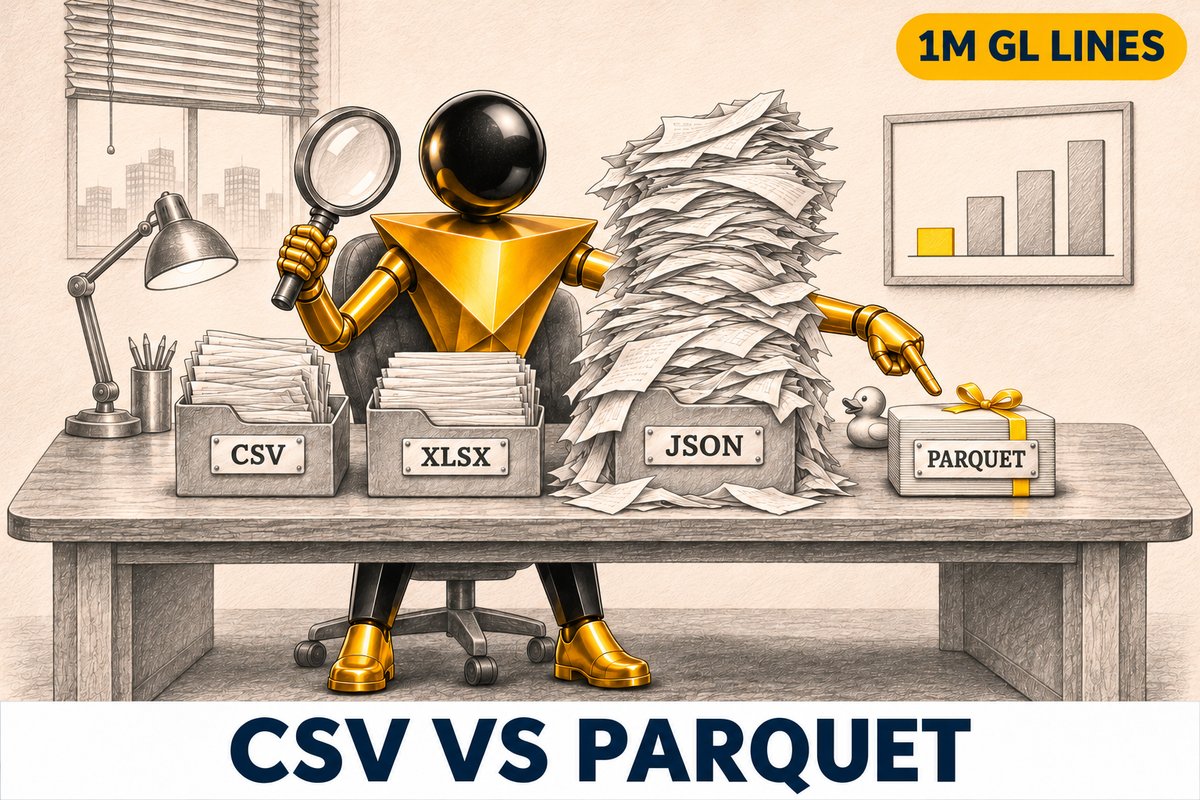
Use Excel for small models and reports people edit, CSV to move data between systems, JSON for app and API feeds with nested records, and Parquet for analysis. In our test Parquet was 9× smaller than CSV, opened in 0.2 seconds against 17.6 for Excel, and kept dates and account codes exactly as saved. It is also the format inside every Microsoft Fabric table.
The same 1,000,000 general-ledger lines from DATA DARE DD-CON-004, saved and opened in eleven file formats.
CSV, Excel and JSON store a ledger the way you read it — one line after another. To total one column, a tool has to read every line in full.
Parquet stores the same ledger column by column, compressed, with the data type of each column written into the file. A question about amounts by entity reads two columns and skips the rest, and repeated values like entity codes shrink to almost nothing. That is why it was 9× smaller than CSV and read two columns in 0.06 seconds.
Six head-to-heads, decided by the test and by what each format was built for.
Pick for analysis: Parquet
9× smaller (11 MB vs 100 MB), opens in 0.2 s vs 2.0 s, and dates and account codes come back exactly as saved.
Keep the other when: you must send a file anyone can open, or a system only exports CSV.
Pick for analysis: CSV for data, Excel for people
CSV saved 1 million lines in 4.4 s; Excel took 2 min 23 s and stops at 1,048,576 rows per sheet.
Keep the other when: the file is a model or report people edit, with formulas and formatting.
Pick for analysis: CSV for flat tables
JSON was 434 MB against 100 MB, because every line repeats every column name.
Keep the other when: the data is nested — a bank statement with its transactions, an API or app feed.
Pick for analysis: Parquet
5× smaller (11 MB vs 59 MB), 90× faster to open, no row limit — the 6.9-million-line ledger behind this test would need 7 Excel sheets.
Keep the other when: the reader must open the file with a double-click.
Pick for analysis: Parquet for storing
Feather (Apache Arrow) was the fastest to write, 0.09 s, but 3× bigger than Parquet (36 MB).
Keep the other when: you are passing data quickly between Python and R on the same machine.
Pick for analysis: Delta when the table changes
Not rivals: a Delta table is Parquet files plus a log of every change. Microsoft Fabric stores every table this way.
Keep the other when: plain Parquet is enough for a one-off export or a monthly snapshot.
Seven formats on what matters to a finance team. Three dots is the best of the group.
| Format | Small files | Fast to open | Keeps dates and codes | Opens in Excel | Readable by eye | Nested data | Power BI and Fabric | Best for |
|---|---|---|---|---|---|---|---|---|
| CSV | Fair | Good | Poor | Best | Best | Poor | Good | Moving data between systems; exports anyone can open. |
| Excel (.xlsx) | Fair | Poor | Good | Best | Best | Poor | Good | Models and reports people edit — under a million rows. |
| JSON | Poor | Fair | Fair | Fair | Good | Best | Good | API and app feeds; nested records like bank statements. |
| Parquet | Best | Best | Best | Poor | Poor | Good | Best | Analysis, Power BI, Microsoft Fabric — anything over a million rows. |
| Feather (Arrow) | Good | Best | Best | Poor | Poor | Fair | Fair | Fast hand-off between Python and R. |
| Avro | Best | Fair | Best | Poor | Poor | Best | Fair | Streaming pipelines where the schema travels with each record. |
| DuckDB file | Best | Good | Best | Poor | Poor | Good | Fair | A whole analysis database in one file on your laptop. |
findi360 rating, from the test on this page and each format's documentation. "Opens in Excel" means a double-click; Excel and Power BI can import more formats through Power Query.
AI can explain a file format. Only real files teach you what goes wrong. DATA DARE sets climb the same ladder as finance data — and each comes with graded questions.
| Format | Level | Practise on | What you will practise |
|---|---|---|---|
| Excel workbook | L1 | DD-GLT-001 · General ledger & trial balance | One workbook: journal lines, budget, accounts and cost centres on separate sheets. |
| Excel workbook | L1 | DD-ARC-001 · Receivables | Invoices and receipts in one file — ageing and collections in Excel or Power BI. |
| CSV tables | L2 | DD-CON-002 · Group consolidation | A trial balance in CSV with linked tables — set the data types before you join. |
| CSV batches | L2 | DD-TRF-002 · Data transformation | Four quarterly CSV files to append, clean and reconcile. |
| JSON feed | L2 | DD-ARC-002 · Receivables | Customer remittances as JSON, beside a CSV ledger and Excel targets. |
| All four formats | L3 | DD-GLT-003 · General ledger & trial balance | Parquet journals, a CSV trial balance, JSON bank statements nested by statement, an Excel budget — one month-end close. |
| Parquet | L3 | DD-CON-003 · Multi-currency consolidation | Trial balances and intercompany tables in Parquet, with FX rates. |
| Parquet partitions | L4 | DD-TRF-004 · Data transformation | Twelve monthly Parquet files to read as one table. |
| Parquet at scale | L4 | DD-CON-004 · Diversified group close | The 6.9-million-line ledger behind this test — too big for one Excel sheet. |
| Parquet at scale | L5 | DD-MFG-005 · Manufacturing | A 368 MB general ledger from three ERPs. |
Downloads need a free findi360 account. Levels rise from L1 (start here) to L5.
| Format | Size | Save | Open all | Open 2 columns | Dates back as dates? |
|---|---|---|---|---|---|
| CSV | 100.5 MB | 4.4 s | 2.0 s | 0.51 s | No — text |
| CSV (gzip) | 12.2 MB | 6.9 s | 1.8 s | 0.57 s | No — text |
| JSON | 434.2 MB | 4.2 s | 8.8 s | — | No — text |
| JSON Lines | 434.2 MB | 6.0 s | 10.2 s | — | No — text |
| Excel (.xlsx) | 58.5 MB | 143.3 s | 17.6 s | 22.2 s | Yes |
| Parquet | 11.1 MB | 0.30 s | 0.20 s | 0.06 s | Yes |
| Feather (Arrow) | 35.7 MB | 0.09 s | 0.16 s | 0.02 s | Yes |
| ORC | 46.7 MB | 0.55 s | 0.25 s | 0.03 s | Yes |
| Avro | 13.5 MB | 32.0 s | 17.0 s | — | Yes |
| SQLite | 106.5 MB | 4.9 s | 6.3 s | 0.84 s | No — text |
| DuckDB file | 14.4 MB | 1.2 s | 1.4 s | 0.13 s | Yes |
Median of three runs (one run for JSON, Excel and Avro). "—": the format has no way to read only some columns. DD-CON-004 is a Level 4 set with hidden answers, so only sizes and timings are shown.
CSV stores everything as text and leaves the reader to guess the types. When we read the CSV back with Python's default settings, the same account code — for example 200000 — came back as text in about the first quarter of the file and as a number in the rest. A lookup or merge on account code would quietly miss rows, with no error.
Excel has its own version of the trap: open a CSV by double-click and codes such as 00123 lose their leading zeros. Parquet, Excel workbooks and DuckDB files store the type with the data, so the code comes back exactly as it was saved.
Tell the reader which columns are codes, or switch the file to Parquet:
import pandas as pd

# CSV: say which columns are codes, so they stay text
gl = pd.read_csv('gl.csv', dtype={'LocalAccountCode': str, 'JournalID': str},
                 parse_dates=['PostingDate'])

# Parquet: types are stored in the file — nothing to set
gl = pd.read_parquet('gl.parquet')
gl.to_parquet('gl.parquet') # convert once, then share the Parquet filePower BI Desktop reads Excel, CSV, XML, JSON, PDF and Parquet files through Get Data. For small files the choice hardly matters; for a ledger of millions of lines, Parquet loads faster and arrives with its types already set.
Microsoft Fabric goes further: every lakehouse and warehouse table in OneLake is stored as Delta Parquet, and Power BI's Direct Lake mode reads those Parquet files directly. A finance team that learns Parquet now is learning the format its future reports will run on.
The data pack has the results, the scorecard, the list of DATA DARE sets by format and a notebook that saves and times the eleven formats on your own laptop. Point it at the DD-CON-004 ledger from DATA DARE — or at any Data Dare set — and compare.
Parquet is an open file format that stores a table column by column, compressed, with the type of each column saved in the file. It was released by Twitter and Cloudera in 2013 and is now the standard file for analysis in Power BI, Microsoft Fabric, Python, Spark and DuckDB.
For analysis, yes. In our test on 1,000,000 general-ledger lines, Parquet was 9× smaller (11 MB vs 100 MB), opened 10× faster (0.2 s vs 2.0 s) and kept dates and account codes as saved. CSV is still the right choice when a file must open anywhere.
Not with a double-click. Power BI Desktop has a Parquet connector; for Excel, convert the file with Python or DuckDB, or load it into Power BI and analyse it there.
1,048,576 rows and 16,384 columns per worksheet. The 6.9-million-line ledger in DATA DARE DD-CON-004 would need seven sheets — which is why large ledgers are kept in Parquet.
CSV has no types, so every tool guesses. Excel drops leading zeros from codes, and Python read the same account code as text in one part of our file and as a number in the rest. Set code columns to text when you read the file, or use Parquet, which stores the type.
For nested data from apps and APIs — a bank statement with its transactions, a payment run with its invoices. For flat tables JSON is wasteful: our 1 million lines took 434 MB, because every line repeats every column name.
Delta Parquet. Every table in a Fabric lakehouse or warehouse is stored in OneLake as Parquet files with a Delta transaction log, and Power BI's Direct Lake mode reads them directly.
On findi360's DATA DARE: free finance datasets with graded questions, from one Excel workbook at Level 1 to millions of ledger lines in Parquet at Levels 4 and 5. DD-GLT-003 has all four formats in one month-end close.

Data pack (workbook + notebook) — the test results, the format scorecard, the list of DATA DARE sets by format, and a notebook that repeats the test on your own laptop.
The story in 9 slides (PDF) — open to everyone, ready to share.
Downloads need a findi360 account — create one in a minute and the file starts straight away. Already a member? Sign in
0 members have picked so far. Each member counts once, with their latest pick.
Sign in to add your view and your pick — it takes a minute.
No comments yet — be the first to answer.
| Figure | Source | Date |
|---|---|---|
| Test data: first 1,000,000 of 6,884,744 GL lines | DATA DARE DD-CON-004 (findi360) | Oct 2026 |
| Sizes and timings (pandas 3.0.5, pyarrow 26.0.1, DuckDB 2.0.0, fastavro 1.13.1) | findi360 test | 17 Nov 2026 |
| CSV in IBM Fortran 1972; RFC 4180 in 2005 | Wikipedia — Comma-separated values | 2026 |
| JSON: Crockford 2001; ECMA-404 2013; RFC 8259 2017 | Wikipedia — JSON; twobithistory.org | 2026 |
| Excel 1.0 for the Mac 30 Sep 1985; Windows 1987; binary .xls until Excel 2007 | Wikipedia — Microsoft Excel | 2026 |
| Sheet size 65,536 × 256 (Excel 97–2003) to 1,048,576 × 16,384 (Excel 2007+) | Office Watch — Excel: a history of rows and columns | 2021 |
| Office Open XML approved by Ecma 7 Dec 2006; default from Excel 2007 | Microsoft News; Library of Congress | 2006 |
| Excel: 1,048,576 rows × 16,384 columns per sheet | Microsoft Support — Excel specifications and limits | 2026 |
| Parquet: Twitter + Cloudera, announced March 2013, 1.0 July 2013 | Wikipedia — Apache Parquet; Cloudera blog | 2013 |
| ORC: Hortonworks with Facebook, February 2013 | Wikipedia — Apache ORC | 2013 |
| Avro proposed by Doug Cutting, April 2009 | Apache Hadoop mailing list (via PuppyGraph) | 2009 |
| Apache Arrow top-level project 17 Feb 2016; Feather | Dremio — Origin and history of Apache Arrow | 2018 |
| Delta Lake open-sourced April 2019 | BigDATAwire | 24 Apr 2019 |
| OneLake stores tables as Delta Parquet; Direct Lake reads Delta tables | Microsoft Learn — OneLake overview; Delta Lake in Fabric | 2026 |
| Power BI Desktop file connectors incl. Parquet | Microsoft Learn — Data sources in Power BI Desktop | 2026 |
Compiled by findi360 from the public sources listed above. Not investment advice. © findi360 — share freely with attribution. Visit findi360 to learn data and finance.